
How feedback improves learning outcomes for educators
How feedback improves learning outcomes for educators

Feedback is one of the most frequently cited factors in improving student achievement, yet its impact in classrooms rarely matches its potential. The central problem is that many educators treat feedback as a volume exercise, assuming that more comments, more corrections, and more annotations will naturally translate into progress. Research tells a different story. Understanding precisely how feedback improves learning outcomes requires a close examination of what feedback does at a cognitive level, how its design either closes or widens the gap between where students are and where they need to be, and why students with special educational needs (SEN) are particularly vulnerable when feedback misses the mark. This guide addresses all three.
Table of Contents
- What makes feedback effective? Understanding the core principles
- Types and timing of feedback: tailoring to learner needs
- How feedback improves memory, understanding, and transfer
- Applying feedback strategies for diverse learners and SEN contexts
- Summary of best practices and evidence-based feedback guidelines
- Rethinking feedback: what most educators miss
- Enhance learning outcomes with Qwixl’s feedback tools
- Frequently asked questions
Key Takeaways
| Point | Details |
|---|---|
| Feedback quality over quantity | Targeted, actionable feedback aligned with learning goals produces bigger gains than more frequent generic comments. |
| Feedback timing is context-dependent | Immediate feedback suits new skills, but delayed feedback aids retention and application in many settings. |
| Match feedback type to goals | Explanatory feedback supports transfer and generalization; simple corrections aid memory encoding. |
| Support diverse learners | SEN students benefit from scaffolded, precise next steps and combined cognitive and motivational feedback. |
| Feedback drives self-regulation | Effective feedback helps students accurately assess their learning and fosters autonomy and engagement. |
What makes feedback effective? Understanding the core principles
The foundational work on feedback in education comes from researchers John Hattie and Helen Timperley, whose model frames feedback around three core questions: Where is the learner going? How are they progressing? And what do they need to do next? This framework remains the most cited in the field because it captures something deceptively simple — feedback only improves learning when students can act on it.
Effective feedback is most powerful when it closes the gap between a learner’s current performance and a desired goal by answering those three questions. Without clear learning intentions and success criteria, feedback becomes noise. A student who receives “good effort but needs improvement” without knowing what improvement looks like is left with no actionable path forward.
Key principles that distinguish impactful feedback from ineffective comment-leaving include:
- Alignment with learning goals: Feedback must reference specific objectives the student understands, not vague standards.
- Actionability: Each piece of feedback should translate directly into a next step the student can attempt.
- Clarity of success criteria: Students need to know what “done well” looks like before feedback about progress means anything.
- Frequency within a learning cycle: Feedback given once at the end of a unit has far less impact than feedback embedded throughout the learning process.
“The most effective feedback does not tell students what is wrong. It tells them precisely what to do differently, relative to a goal they understand and have internalized.”
Teachers who ground their research on feedback improvement in these principles consistently see stronger gains than those who rely on frequency alone. The design of the feedback, not the amount, is what drives the impact of feedback on learning.
Types and timing of feedback: tailoring to learner needs
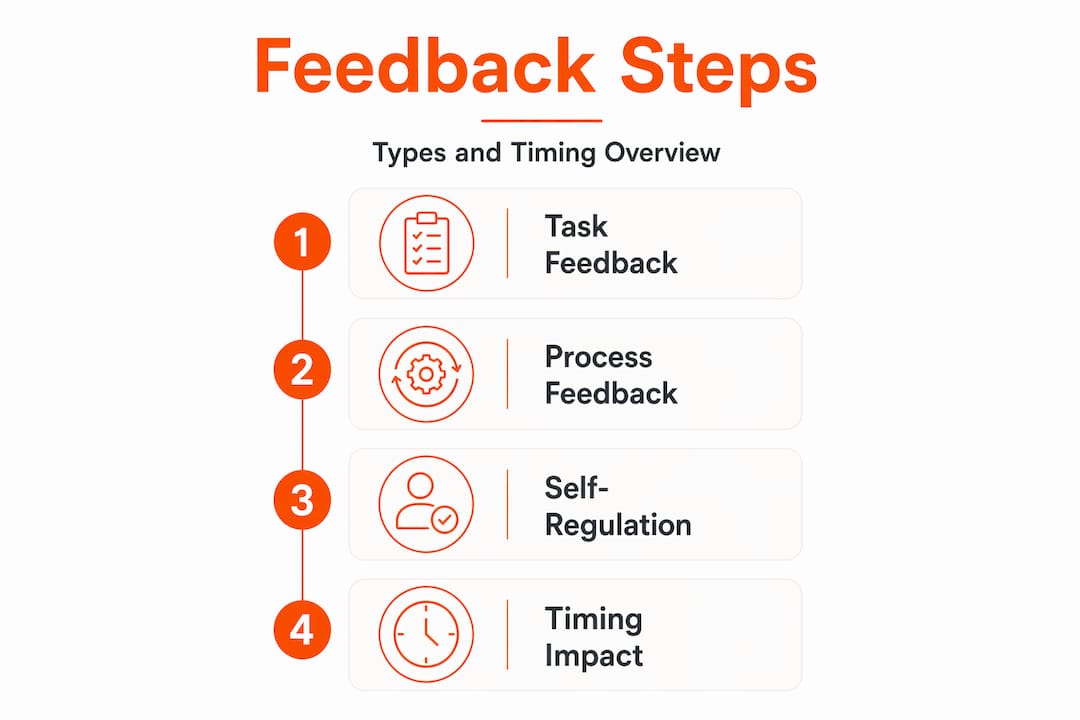
Not all feedback serves the same purpose, and matching feedback type to learner proficiency is one of the more nuanced skills in teaching. Three levels dominate the research: task-level, process-level, and self-regulation feedback.
Task-level feedback is most useful for novice learners and early skill acquisition. It identifies specific errors and realigns the student with the learning intention. This type of feedback is direct and corrective, appropriate when students do not yet have the prior knowledge to benefit from more elaborated guidance.
Process-level feedback is suited to students with some foundational knowledge who need to develop their strategies, not just fix individual errors. It guides students to evaluate their own approach and make more informed decisions in subsequent attempts.
Self-regulation feedback is reserved for proficient learners. It encourages students to monitor their own progress, set sub-goals, and develop independence, which is central to long-term academic success.
Timing adds another layer of complexity. Feedback timing significantly influences outcomes but is context-dependent, with benefits to short feedback-response cycles rather than always-immediate feedback, according to a recent meta-analysis. The practical implication is that immediate feedback is most beneficial when students are learning new skills and errors can become entrenched, while delayed feedback often serves better for complex application tasks where reflection is part of the learning.
| Feedback type | Best used when | Key benefit |
|---|---|---|
| Task-level | Learning new content | Corrects errors, aligns with goals |
| Process-level | Developing strategies | Deepens understanding |
| Self-regulation | Advanced learners | Builds independence |
| Immediate | New skill acquisition | Prevents misconceptions |
| Delayed | Application tasks | Encourages reflection |
Digital environments require particular attention. Online feedback shows moderate positive effects with stronger cognitive than affective gains, suggesting a need to plan complementary routines for motivation and engagement alongside digital delivery. This is an important caution for schools increasing their reliance on automated feedback tools without accompanying emotional and motivational support structures.
- Identify which stage of learning the student is at before choosing feedback type.
- Pair digital or written cognitive feedback with regular verbal check-ins to address motivation.
- Build short feedback-response cycles into lesson sequences rather than reserving feedback for after assessments.
- Adjust the feedback type as proficiency grows, moving students toward self-regulation over time.
Pro Tip: For students accessing practical feedback strategies for SEN through digital tools, schedule brief follow-up conversations to ensure cognitive feedback is understood and emotionally processed. Written comments alone rarely sustain motivation for students who find learning effortful.
How feedback improves memory, understanding, and transfer
The cognitive mechanisms behind feedback are more specific than many educators realize. Feedback does not simply confirm correct answers. It actively shapes how information is encoded, retrieved, and generalized.

Practice with explanatory feedback supports both memory and stronger generalization; correct-answer feedback aids memory but not transfer; and metacognitive calibration is improved by practice with feedback versus passive lecture. This distinction matters enormously in practice. If you want a student to remember a fact, telling them the correct answer when they err is sufficient. If you want them to apply that knowledge to a new problem, they need explanatory feedback that walks them through the reasoning.
Effective feedback for learning, understanding, and transfer involves:
- Explanatory feedback over correct-answer feedback when the learning goal involves application or generalization to new contexts.
- Retrieval practice with feedback rather than re-reading or passive review, because attempting recall and then receiving corrective feedback strengthens encoding significantly more than lecturing.
- Matching feedback elaboration to prior knowledge: Students with limited prior knowledge on a topic can be overwhelmed by elaborated feedback. Simpler, more direct task-level feedback works better until foundational understanding is established.
- Using feedback to calibrate metacognition: When students receive consistent feedback cycles, they become more accurate at judging what they do and do not yet understand, a skill that compounds over an academic career.
The implication for teachers is that varying effective feedback strategies depending on whether the goal is retention or transfer is not a minor adjustment. It is a fundamental design decision that shapes whether students leave a unit able only to recall facts or genuinely able to think with the material.
Pro Tip: When designing assessments, be explicit about whether the goal is memory or transfer. This will directly inform which feedback type to deploy and save time by preventing elaborate explanatory feedback on tasks where simple correction would suffice.
Applying feedback strategies for diverse learners and SEN contexts
For students with SEN, the stakes of getting feedback right are higher, and the margin for error is smaller. These students are disproportionately likely to receive feedback that is technically accurate but practically useless because it fails to account for their cognitive and affective starting points.
Explanatory and procedural feedback aids transferable understanding beyond just immediate correction, and actionable scaffolded next steps prevent feedback from being correct but unusable. This is a particularly urgent concern for students with neurodevelopmental conditions such as dyslexia, attention deficit hyperactivity disorder (ADHD), or autistic spectrum conditions, where working memory limitations and executive function differences can mean that even well-intentioned feedback does not translate into improved performance without additional scaffolding.
Practical strategies for teachers and SENCOs working with diverse learners include:
- Be specific about the next action: Replace “revise this paragraph” with “rewrite the opening sentence to include a cause and identify who was affected.”
- Avoid generic praise: Phrases like “well done” or “good try” carry no information and can actually undermine motivation when students sense the praise is not connected to specific achievement.
- Sequence feedback in steps: For students with working memory difficulties, providing one or two targeted next steps is more effective than a comprehensive list of corrections.
- Create psychological safety: Students who fear that feedback signals failure will disengage. Framing feedback as a normal, expected part of every learning cycle reduces anxiety and increases willingness to act on it.
- Align with individual education plans: SENCOs should ensure that the feedback students receive in class is consistent with the goals set out in their support plans, preventing conflicting signals that create confusion.
The opportunity for tailoring feedback for SEN learners is greatest when teachers and SENCOs work collaboratively, using shared evidence about each student’s response to different feedback types to refine their approach over time. For more structured guidance, feedback techniques for SENCOs can support this collaboration with frameworks built around individual learning profiles.
Summary of best practices and evidence-based feedback guidelines
Effective feedback is a core explicit teaching strategy linked to motivation, engagement, and achievement when aligned to learning intentions and used to guide next steps. Translating that principle into daily practice requires discipline across multiple dimensions.
| Feedback principle | Key action | Common failure mode |
|---|---|---|
| Align to learning goals | Reference specific intentions in all feedback | Feedback unconnected to stated objectives |
| Provide actionable next steps | Name a specific, achievable next task | Vague comments with no direction |
| Match type to proficiency | Use task, process, or self-regulation level | One-size-fits-all feedback regardless of skill |
| Time feedback appropriately | Immediate for new skills; delayed for application | Uniform timing across all task types |
| Support motivation | Pair cognitive feedback with emotional safety | Feedback that is technically accurate but demotivating |
| Create feedback cycles | Build in opportunities to act and reflect | Feedback given once with no follow-up |
Practical guidelines for implementing these principles consistently include:
- Focus each piece of feedback on one or two of the most critical gaps relative to the learning intention, not every error observed.
- Build short-cycle feedback loops into lesson sequences rather than reserving all feedback for summative moments.
- Periodically ask students to identify what they will do differently based on the feedback they received. This builds metacognitive awareness and helps you identify whether your feedback was understood.
- Track patterns in how individual students respond to different feedback types using feedback best practices and adjust your approach as their proficiency develops.
Improving outcomes through feedback is not a single intervention. It is a sustained, evidence-informed practice that evolves with each student’s needs.
Rethinking feedback: what most educators miss
The most persistent problem in feedback practice is not that educators give bad feedback. It is that they give feedback students cannot use. A comment may be accurate, insightful, and even kind, yet still fail to move a learner forward if it does not answer the question: what exactly should I do next?
A common failure is feedback that is correct but not usable. Actionable next tasks aligned to goals are essential, especially for SEN learners. This is a systemic issue, not an individual one. Schools that invest in professional learning around expert feedback guidance consistently find that teachers already understand the principles but lack structured time and tools to apply them reliably across every student interaction.
There is also a widespread assumption that faster feedback is always better. The evidence challenges this directly. Timing effects are context-dependent, and rapid feedback is not always better, especially in classroom multi-day cycles where students need processing time before they can act meaningfully. The urgency schools feel to return marked work quickly can paradoxically reduce the quality of feedback by prioritizing speed over clarity and actionability.
The final, most frequently overlooked dimension is the affective one. Feedback that is cognitively precise but delivered in a way that triggers shame, anxiety, or learned helplessness will not improve performance, regardless of its technical quality. For SEN students in particular, creating a psychologically safe environment where feedback is normalized and depersonalized is not a soft add-on to good teaching. It is a precondition for any feedback to work at all. Feedback should be understood not as a marking task but as a dynamic communication cycle, one that requires reflection, application, adjustment, and the student’s genuine belief that acting on feedback will lead somewhere worthwhile.
Enhance learning outcomes with Qwixl’s feedback tools
Translating evidence-based feedback principles into daily practice requires more than good intentions. It requires tools that give teachers and SENCOs real, actionable information about where each student is in their learning and what they need next.

Qwixl Homework uses AI-assisted analysis to surface feedback insights tailored to individual learners, including screening indicators for professional review, so that the feedback teachers give is grounded in evidence rather than impression. Qwixl Milo integrates directly with Google Docs to provide in-the-moment support and SEN-relevant signals during the writing process itself, bridging the gap between assignment and assistance. Both tools are designed around the same principles this article covers: clear learning goals, actionable next steps, and respect for cognitive diversity. If you are ready to bring these principles into your classroom systematically, getting started with Qwixl takes minutes and the impact compounds quickly.
Frequently asked questions
What are the key elements that make feedback effective for student learning?
Effective feedback is specific, focused on learning goals, actionable with clear next steps, and timely, allowing students to understand and close gaps in their knowledge or skills. Feedback is most powerful when it addresses where the learner is going, how they are progressing, and what to do next.
How does the timing of feedback affect learning outcomes?
Feedback timing impacts learning but depends on context; immediate feedback benefits new skill acquisition, while delayed feedback can aid application and retention, especially when students have opportunities for quick response. Timing effects are context-dependent, meaning short feedback-response cycles often outperform always-immediate delivery.
Why is explanatory feedback important for students with special educational needs?
Explanatory feedback helps SEN students develop deeper, transferable understanding beyond immediate corrections, supporting both memory and generalization essential for long-term learning. Without scaffolded next steps, feedback for additional needs learners risks being technically accurate but practically unusable.
Can online feedback replace traditional in-person feedback in classrooms?
Online feedback can effectively improve cognitive learning outcomes but often requires complementary strategies to support student motivation and affective needs that in-person interaction typically provides. Online feedback effects are stronger on cognitive than affective outcomes, meaning digital tools should be paired with relational support structures.