
How Adaptive Feedback Helps Students Succeed in Class
How Adaptive Feedback Helps Students Succeed in Class
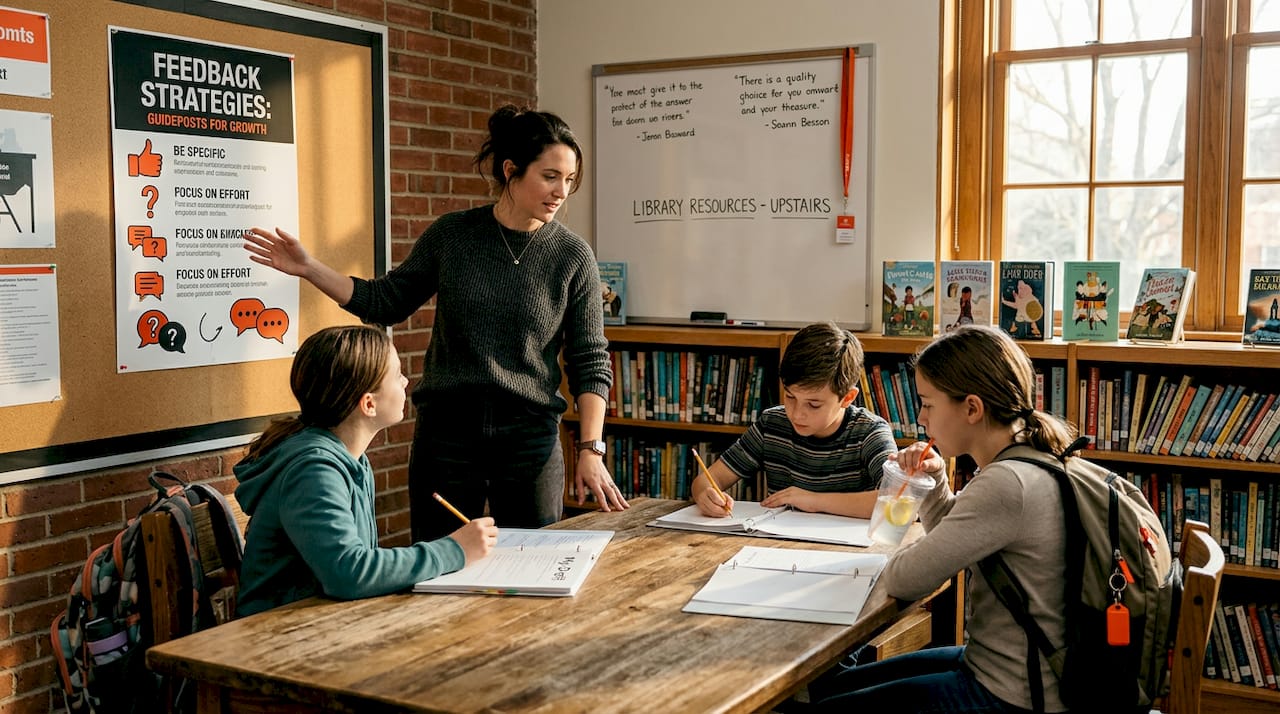
Feedback is one of the most studied variables in educational research, yet it remains one of the most inconsistently applied tools in classrooms. Understanding how adaptive feedback helps students goes well beyond marking answers right or wrong. When feedback is calibrated to a student’s current understanding, delivered at the right moment, and framed within a trusting classroom environment, it can dramatically shift both engagement and academic performance. This guide offers educators a research-grounded, practical framework for applying adaptive feedback in ways that genuinely move students forward.
Table of Contents
- Key takeaways
- How adaptive feedback helps students learn differently
- The mechanisms: why personalized feedback works
- Techniques and tools for adaptive feedback in practice
- Implementing adaptive feedback: common pitfalls
- Measuring and sustaining the benefits over time
- My perspective: what classrooms have actually taught me
- How Qwixl supports adaptive feedback in your classroom
- FAQ
Key takeaways
| Point | Details |
|---|---|
| Adaptive feedback outperforms correction | Elaborated, adaptive feedback is twice as effective as simple right-or-wrong responses in improving learning outcomes. |
| Emotional safety is non-negotiable | Students only engage fully with feedback when they feel psychologically safe to make mistakes without judgment. |
| Behavioral signals reveal hidden struggles | Response timing and engagement patterns offer deeper insight into student mastery than correctness alone. |
| Acting on feedback data matters most | Collecting feedback without adjusting instruction limits its impact; adaptive teaching demands a response. |
| Technology can scale personalization | Digital tools that analyze writing and engagement signals allow teachers to deliver timely, individualized support across whole classrooms. |
How adaptive feedback helps students learn differently
Most educators understand feedback as something that happens after a task. A grade returned, a comment written, a correction offered. Adaptive feedback operates on a different logic entirely. It is feedback calibrated in real time to what a student currently knows, how confidently they know it, and what specific gap or misconception is holding them back.
Research quantifies this distinction clearly. Effective feedback achieves an effect size of 0.70 to 0.73 on student achievement, surpassing most other instructional interventions. When feedback is delivered through adaptive online systems, that figure climbs further, with cognitive outcome effect sizes reaching 1.238 in recent meta-analyses. These are not marginal gains. They represent the difference between a student consolidating understanding and one quietly accumulating misconceptions across a term.
“Adaptive feedback shifts the teacher’s role from evaluator to coach, responding to where a student actually is rather than where the curriculum expects them to be.”
The distinction between elaborated feedback and simple feedback is equally significant. Simple feedback tells a student they are wrong. Elaborated feedback explains why, suggests what to do next, and connects the error to a broader concept. Elaborated feedback is twice as effective as simple correct-answer feedback in improving student performance. This evidence aligns directly with formative assessment principles: the goal is not to judge a final product but to inform the next learning step.
Adaptive feedback also connects to metacognition. When students receive feedback that models how to think about a problem, not just what the right answer is, they gradually internalize those thinking strategies. This is the mechanism by which feedback improves learning at the deepest level: it teaches students to monitor and regulate their own understanding over time.
The mechanisms: why personalized feedback works
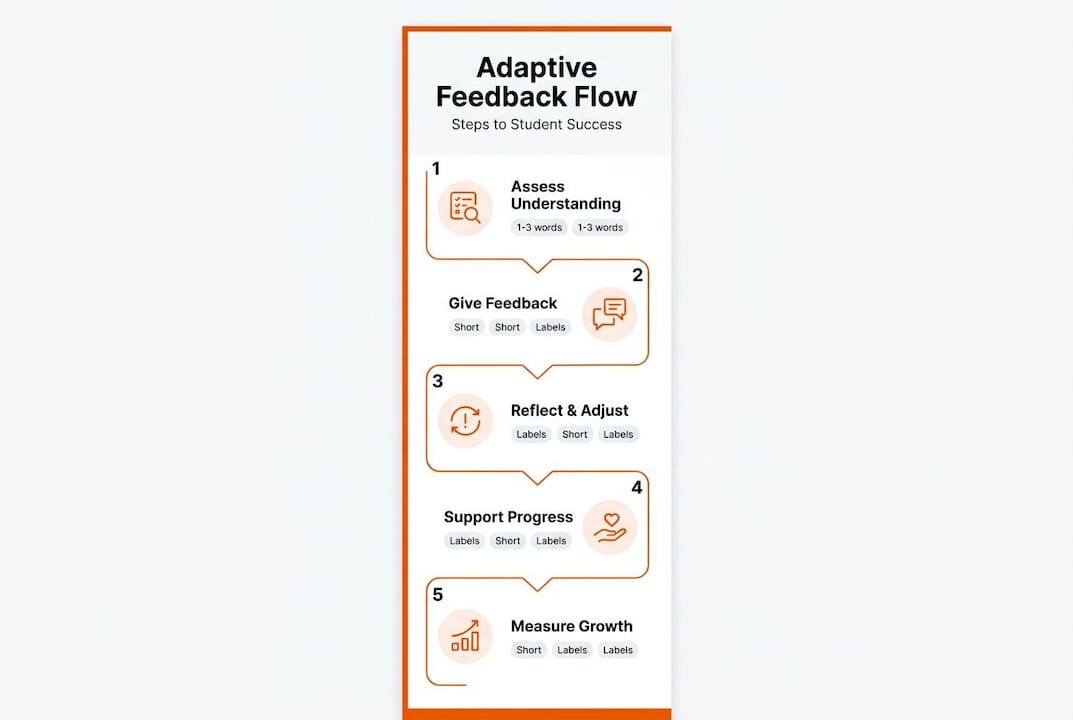
Understanding the mechanics of adaptive feedback helps educators deploy it with intention rather than instinct. At its core, adaptive feedback works through several interconnected processes.

Scaffolding without ceiling. Adaptive feedback meets students at their level and offers precisely enough support to move them forward without doing the cognitive work for them. A student who has a partial understanding of a concept needs different feedback than one who has a fundamental misconception. Treating both the same wastes one student’s time and leaves the other further behind.
Emotional safety as a prerequisite. Emotional safety and relationship quality are critical determinants of whether students receive and act on feedback at all. A student who perceives a correction as a judgment of their intelligence will defend against it. A student who trusts their teacher and feels secure making mistakes will process it productively. Growth mindset and emotional maturity are not just personality traits; they are conditions that skilled educators actively create in their classrooms.
Self-regulation and student agency. Adaptive feedback builds self-regulation by giving students frameworks for self-assessment. When feedback consistently models the question “What did I understand, and what do I still need to work on?”, students begin asking that question independently. This is a long-term investment. The short-term payoff is better test results; the long-term payoff is students who can direct their own learning.
- Students with higher self-confidence respond better to elaborative feedback that challenges them further.
- Students with lower self-confidence benefit most from feedback that first acknowledges what they did correctly before addressing gaps.
- Students showing signs of disengagement often need feedback on process and effort rather than accuracy.
- Students with special educational needs may require feedback adjusted not just in content but in format, timing, and medium.
Pro Tip: When delivering verbal feedback to a student who appears withdrawn or resistant, begin by naming something specific and accurate they did. This is not flattery. It is a signal that you have actually read their work, which opens the door for critical feedback to land.
Behavioral signals like response time provide a layer of insight that goes beyond correctness. A student who answers within five seconds may be guessing; one who takes over 45 seconds may be struggling in ways the answer alone does not reveal. Adaptive feedback that incorporates these signals allows teachers to intervene at the right moment, before a misunderstanding calcifies into a persistent gap.
Techniques and tools for adaptive feedback in practice
Classroom implementation of adaptive feedback does not require a technology overhaul. Some of the most effective techniques are analog, low-cost, and immediately deployable.
- Mini whiteboards allow every student in the class to display an answer simultaneously. This removes the social risk of being wrong publicly and gives the teacher a real-time view of the entire room’s understanding in one sweep.
- Hinge questions are carefully designed questions placed at decision points in a lesson. The answer a student gives determines which instructional path comes next. A well-written hinge question has wrong answer choices that each map to a specific misconception, telling the teacher exactly where to intervene.
- Finger voting or color-coded response cards give low-stakes, rapid checks across a class without requiring written responses.
- Exit tickets with targeted prompts replace the generic “any questions?” with specific written evidence of understanding that can be sorted in two minutes after class.
Consistent use of techniques like mini whiteboards and hinge questions increases the quality of evidence teachers gather and actively motivates student participation by normalizing the act of being assessed as a learning event rather than a judgmental one.
On the digital side, adaptive assessment tools add a layer of sophistication that analog methods cannot fully replicate. Adaptive assessments reduce total assessment time by 35 to 40 percent while increasing accuracy by 28 percent, adjusting question difficulty in real time based on student responses. AI-powered quiz design, including approaches outlined in adaptive AI-powered learning, extends this further by using quiz performance data to refine both question selection and the feedback delivered.
| Feedback type | Focus level | Example |
|---|---|---|
| Surface feedback | Factual accuracy | “That date is incorrect — the event occurred in 1848.” |
| Deep feedback | Conceptual understanding | “You have the sequence right, but consider why the cause produced that effect.” |
| Transfer feedback | Application to new contexts | “How would this principle apply if the variables changed?” |
Feedback addressing surface, deep, and transfer levels of understanding produces the most durable learning gains, because it moves students beyond memorization into genuine cognitive engagement with the material.
Implementing adaptive feedback: common pitfalls
The most underappreciated challenge in adaptive feedback is not technique. It is follow-through. Teachers often collect feedback without adapting teaching adequately, which makes the feedback loop incomplete and undermines the entire process. Gathering exit ticket data but beginning the next lesson from the same point regardless of what that data showed is one of the most common and most consequential implementation failures.
Several structural and cultural barriers compound this problem:
- Curriculum pressure creates a pervasive sense that slowing down to respond to feedback signals is a luxury rather than a necessity.
- Whole-class feedback tools surface patterns but require teachers to make judgment calls about which gaps warrant whole-group re-teaching versus targeted small-group work.
- Students with unidentified special educational needs may display feedback resistance or inconsistent performance patterns that teachers misread as disengagement.
- Assessment data collected through digital tools is only useful if educators know how to interpret it and have the time to act on it.
Students must perceive mistakes as information, not as reflections of their identity, for adaptive feedback to work. This cultural shift requires deliberate classroom norms: teachers modeling their own uncertainty, praising the quality of a question over the correctness of an answer, and building routines where tentative thinking is genuinely welcomed.
Pro Tip: Reserve ten minutes at the start of each week to review the feedback patterns from the previous week. One recurring misunderstanding in your class data is almost always more important to address than the next planned lesson topic.
Balancing direct intervention with student independence is also a real tension. Adaptive feedback works best when it gradually transfers responsibility to the learner. A teacher who always provides the answer, even a nuanced and elaborated one, is not fully leveraging the mechanism. The goal is feedback that teaches students to ask better questions of themselves.
Measuring and sustaining the benefits over time
Measuring the benefits of adaptive feedback requires looking beyond summative test scores. Formative assessment data, collected consistently and analyzed with attention to trends across weeks rather than individual data points, gives a far more accurate picture of whether feedback is actually influencing learning.
| Measurement approach | What it captures | Recommended frequency |
|---|---|---|
| Exit ticket analysis | Lesson-level understanding gaps | Daily or every other lesson |
| Portfolio or work sample review | Progress in depth of understanding over time | Monthly |
| Student self-assessment surveys | Student perception of their own learning and confidence | Bi-weekly |
| Behavioral engagement data (digital tools) | Response timing, task completion, and effort signals | Ongoing, reviewed weekly |
Encouraging student self-assessment as a complement to teacher feedback is one of the highest-leverage strategies available. When students articulate what they understand and where they are uncertain, they consolidate learning and produce feedback data simultaneously. Adaptive feedback enables teachers to observe learning in progress rather than grading outputs after the fact, and student self-assessment is a direct extension of that philosophy.
Sustaining motivation over time requires attention to the cumulative emotional experience of feedback. Students who receive consistent, specific, and respectful feedback develop a different relationship with assessment than those whose only sustained experience of feedback is a grade at the end of a term. Cultivating this at the school-wide level, embedding adaptive feedback as a shared professional commitment rather than an individual teacher’s practice, is what transforms short-term gains into long-term cultural change.
My perspective: what classrooms have actually taught me
I’ve worked with enough educators to know that the biggest barrier to adaptive feedback is not knowledge. It is not even time, though that matters. The barrier is a quiet, persistent belief that feedback is fundamentally about evaluation rather than learning. I’ve seen teachers collect genuinely rich data from well-designed formative tasks and then use it only to assign a number. The shift toward adaptive feedback requires letting go of that instinct.
What I’ve found consistently is that emotional safety is not a soft concern. It is the most determinative factor in whether feedback lands at all. Emotional maturity and growth mindset shape whether a student opens or closes when you respond to their work. Teachers who build this deliberately, through their daily language, their responses to errors, and their own modeling of uncertainty, get better outcomes from every feedback strategy they apply.
My honest view is that quality matters far more than quantity. Ten pieces of feedback that name a precise gap and suggest a concrete next step will always outperform fifty comments that say “good work” or “try again.” The educators I’ve seen make the biggest difference are not necessarily the ones doing more. They are the ones being more intentional about the feedback they deliver and the conditions they’ve built to receive it.
— Luke
How Qwixl supports adaptive feedback in your classroom
Qwixl was built on the understanding that effective feedback requires more than a red pen or a score. The platform’s tools, including Qwixl Homework and Qwixl Milo, are designed to give teachers the kind of real-time, individualized insight that makes adaptive feedback practical at scale. Qwixl Homework uses AI-driven marking and behavioral signals to surface not just what students got wrong, but how they engaged with the task, identifying SEN-related patterns that might otherwise go unnoticed. For educators working with students who need the most tailored support, Qwixl’s evidence-based tools provide the depth of insight that informs genuinely adaptive teaching. Explore how Qwixl can improve your feedback practice today.
FAQ
What is adaptive feedback in education?
Adaptive feedback is personalized, real-time feedback calibrated to a student’s current level of understanding, including their specific misconceptions, confidence, and learning needs, rather than offering the same response to all students.
How does adaptive feedback improve student achievement?
Research shows effective adaptive feedback has an effect size of 0.70 to 0.73 on student achievement, with elaborated adaptive feedback being twice as effective as simple correct-answer feedback in improving performance.
What role does emotional safety play in feedback effectiveness?
Emotional safety and teacher-student relationship quality are critical for students’ willingness to receive and act on feedback. Students who fear judgment are less likely to engage with corrective or developmental feedback.
How can teachers check understanding using adaptive techniques?
Techniques like mini whiteboards, hinge questions, and exit tickets allow teachers to gather high-quality real-time evidence from every student, making learning gaps visible so instruction can be adjusted immediately.
Can technology support adaptive feedback for SEN students?
Yes. Digital tools that analyze behavioral signals like response timing and writing patterns can identify learning needs beyond correctness alone, supporting earlier, more targeted intervention for students with special educational needs.