
How to Set Up a Homework Feedback System
How to Set Up a Homework Feedback System

Most teachers already know that feedback matters. The struggle is building a system that actually works under real classroom conditions, where time is short, student needs are uneven, and disengagement is a constant variable. Learning how to set up a homework feedback system that is both sustainable and genuinely useful requires more than good intentions. It demands clear structure, deliberate design, and tools calibrated to the realities of your classroom. This article walks through exactly that, from prerequisites to peer assessment integration to the digital platforms now available to support it all.
Table of Contents
- Key Takeaways
- Setting up a homework feedback system: what to do first
- How to build the feedback cycle step by step
- Peer and self-assessment that actually works
- Using technology to scale your feedback system
- Common mistakes that undermine feedback systems
- What I have learned building feedback systems in real classrooms
- How Qwixl supports your homework feedback practice
- FAQ
Key Takeaways
| Point | Details |
|---|---|
| Start with clear goals | Align feedback to specific learning objectives before building any system or choosing any tool. |
| Prioritize speed over depth early | Consistent, timely feedback drives learning gains more reliably than infrequent but detailed responses. |
| Build in revision loops | Feedback without student action is passive. Design assignments so students can reflect and revise. |
| Train students for peer assessment | Peer feedback only works when students understand the criteria and have practiced giving comments. |
| Use technology selectively | Digital homework feedback tools save time but should complement, not replace, teacher judgment. |
Setting up a homework feedback system: what to do first
Before you build anything, you need clarity on what feedback is actually supposed to accomplish in your classroom. That sounds obvious. Most teachers skip it anyway.
Align feedback to learning goals
Feedback that is not connected to specific learning objectives is noise. Students do not know what to do with it, and teachers exhaust themselves producing it. The first step is identifying the two or three learning goals each assignment is designed to practice, then writing your feedback criteria directly against those goals. When feedback serves clear objectives, students understand expectations and can act on what they receive.
Know your feedback types
Not all feedback serves the same purpose, and mixing them without intent creates confusion. Formative feedback is ongoing, low-stakes, and focuses on improvement during the learning process. Summative feedback arrives at the end of a task and evaluates performance. Peer and self-assessment sit between those poles, building metacognitive awareness and reducing dependence on teacher validation. Any system you create should incorporate at least formative and self-assessment components from the start.
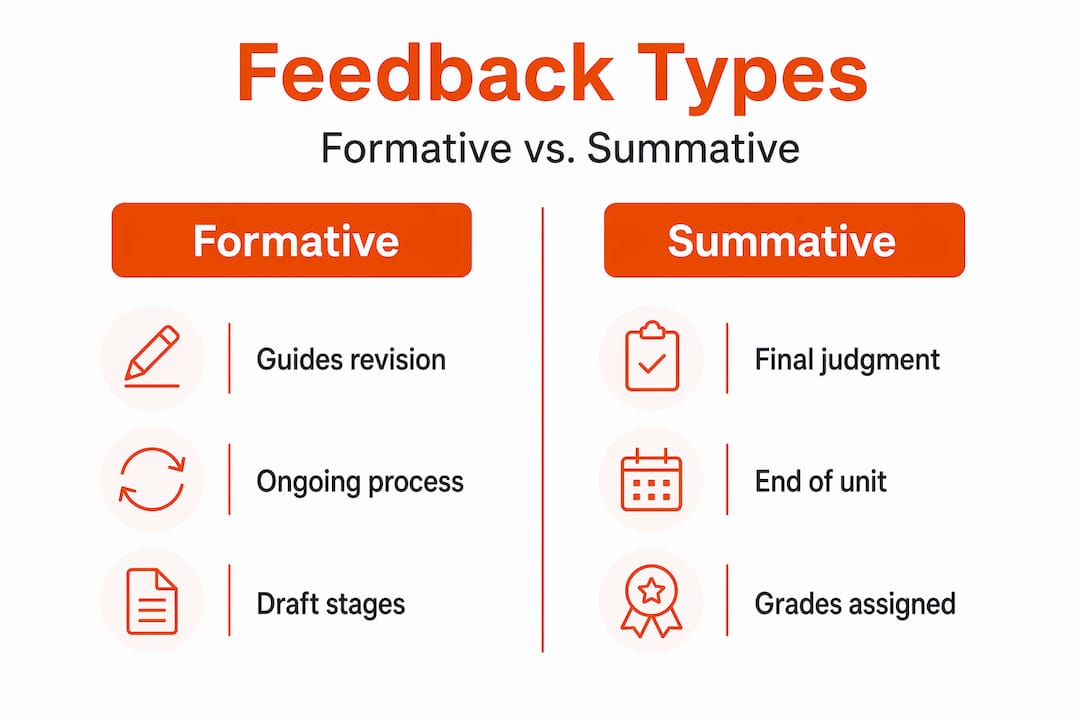
The table below summarizes when each type is most effective:
| Feedback Type | Best used when | Primary benefit |
|---|---|---|
| Formative | During or between drafts | Guides revision and builds skill |
| Summative | After task completion | Evaluates against criteria |
| Peer assessment | Mid-process or post-draft | Develops evaluative thinking |
| Self-assessment | Any stage | Builds self-regulation and ownership |
Pro Tip: Before introducing any new homework feedback tools, spend one class period teaching students what feedback actually is. Students who understand the purpose of feedback engage with it more consistently, and the time investment pays off within weeks.
Research confirms that autonomy-supportive feedback tied to a clear homework purpose strengthens both student effort and self-management. That is the foundation everything else builds on.
How to build the feedback cycle step by step
A feedback cycle is not a single moment. It is a loop. Teachers deliver feedback. Students act on it. Teachers respond to that action. Repeat. Most homework feedback systems fail because only the first step exists.
Here is how to construct a working cycle:
-
Design low-stakes entry points. Regular, brief assignments with specific feedback criteria reduce the pressure for students and make it easier for you to give targeted responses. A paragraph of writing or five practice problems is more useful for feedback than a full essay submitted once a term.
-
Separate comments from scores. When grades appear alongside written feedback, students read the number and ignore everything else. Release comments first, hold scores for 24 to 48 hours, and give students time to read and respond to the feedback before the grade appears. Staged feedback and reflection time is a practice UCLA explicitly recommends for improving the depth of student engagement.
-
Limit feedback to two priorities per assignment. Selecting one or two specific areas to address per assignment, rather than annotating everything, leads to higher student follow-through. Research points directly to this: focused, prioritized comments increase the likelihood that students act on the feedback rather than scan past it.
-
Build in the revision loop. After feedback is delivered, the next assignment or class activity should require students to respond to it. This might be a revised paragraph, a short written reflection on what they changed, or a follow-up question set. The goal is structured action, not passive receipt.
-
Manage your own workload deliberately. Rotate deep feedback across students so you are not annotating every piece of work from every student every week. Use minimal marking codes, whole-class feedback sheets, or audio notes for efficiency. Timely, consistent feedback delivery has been shown to matter more than depth at early system stages.
-
Track patterns across submissions. When you review homework, note recurring errors or misconceptions across the class. Address those in a whole-group session rather than repeating the same comment thirty times individually.
Pro Tip: A whole-class feedback sheet, shared digitally after a set of submissions, lets you highlight common strengths and growth areas without writing individual comments for every student. It also models the kind of analytical thinking you want students to apply to their own work.
Peer and self-assessment that actually works
Peer assessment is one of the most underused and poorly implemented tools in homework feedback. Done badly, it produces vague comments and student frustration. Done well, it builds evaluative reasoning that strengthens a student’s own work as much as the feedback recipient’s.

The research is clear: peer assessment requires clear criteria, training, and repeated practice to generate reliable and useful feedback. That means co-constructing rubrics with students, not just handing them a checklist. When students participate in defining what good work looks like, they internalize the standards and apply them more accurately when reviewing peers.
Several practices make peer assessment more reliable:
- Walk students through sample work and model what a useful comment looks like versus a vague one. “Good job” is not feedback. “Your second paragraph needs a specific example to support the claim” is.
- Require structured formats. A sentence stem like “I noticed… I wonder… I suggest…” gives students a framework that reduces the cognitive load of figuring out how to phrase feedback.
- Run calibration exercises where students rate the same piece of work independently, then compare scores as a class. Discrepancies become teaching moments about criteria interpretation.
- Repeat the cycle frequently. Students get better at peer assessment the more they practice it, and their self-assessment improves in parallel because they are thinking analytically about quality more often.
Self-assessment follows similar principles. Students who are asked to annotate their own work before submission, noting where they are confident and where they are uncertain, consistently produce work that is more thoughtfully prepared. And the teacher receives a clearer signal of where to focus feedback energy. For educators looking to build personalized homework support that scales, this self-annotation habit is one of the highest-leverage practices available.
Pro Tip: Ask students to submit a one-sentence self-assessment with every homework assignment: “The part I am least confident about is…” That single prompt generates more useful feedback data than most rubrics.
Using technology to scale your feedback system
Digital tools have made it genuinely possible to deliver effective homework reviews at a scale that would have required significantly more teacher time a decade ago. The challenge is not finding tools. It is selecting them with enough discrimination to avoid adding complexity without adding value.
The table below compares approaches to automated and teacher-led digital feedback:
| Approach | Speed | Depth | Best suited for | Limitation |
|---|---|---|---|---|
| Automated platform feedback | Immediate | Low to moderate | Practice tasks, quizzes, short responses | May miss nuance in open-ended work |
| Audio or video teacher feedback | Slower | High | Complex essays, creative work, SEN students | Time-intensive to produce |
| Whole-class digital feedback sheets | Fast | Moderate | Common errors, shared misconceptions | Less individual, needs follow-up |
| Peer review via digital platform | Moderate | Moderate | Drafts, structured tasks | Quality depends on student training |
One finding that should shift how teachers think about automated feedback for assignments: a meta-analysis of e-homework research found no significant difference in learning outcomes between results-only feedback and explanation-rich feedback in digital systems, with effect sizes of 0.456 versus 0.258 respectively. What this suggests is that consistency and timeliness of delivery often matter more than the depth of any individual feedback message, particularly at the start of building a student feedback system.
Audio and video feedback are worth the extra effort for specific students and complex tasks. Multi-modal feedback increases engagement and provides richer communication, particularly for students who struggle to decode dense written comments. For students with learning differences or neurodevelopmental conditions that affect reading, an audio note can deliver the same content with significantly less processing demand.
Educators interested in formative assessment approaches that integrate digital feedback should prioritize tools that allow students to respond within the same platform, keeping the revision loop intact without requiring a separate workflow.
Common mistakes that undermine feedback systems
Even well-designed feedback systems erode over time. These are the patterns most likely to cause that.
- Feedback overload. Teachers annotate everything, students read nothing. Limiting feedback to one or two priorities per assignment, as the research consistently recommends, is not a compromise. It is a more effective method.
- No student action required. If homework can be submitted and never revisited, feedback becomes a closing statement rather than a teaching tool. Every feedback cycle must build in a required next step, even a brief one.
- Inconsistent delivery timelines. Students disengage from feedback when it arrives unpredictably or long after submission. A feedback quality perception study of 1,426 students found that the perceived quality of feedback directly predicted motivation and self-regulation. Late or irregular feedback erodes that perception quickly.
- No modeling of how to use feedback. Students often do not know how to read feedback productively. Spend time explicitly demonstrating what it looks like to receive a comment, interpret it, and make a specific revision.
The most sustainable homework feedback system is not the one with the most features. It is the one that teachers can maintain consistently and that students are genuinely trained to use.
What I have learned building feedback systems in real classrooms
In my experience, the biggest mistake educators make when they try to improve homework feedback is beginning with the tool rather than the structure. A new platform does not fix a feedback system that lacks clear criteria, student training, or revision cycles. I have watched well-resourced schools spend significant time implementing digital platforms that teachers stopped using within a semester because the underlying habits were not in place.
What I have found actually works is starting small and intentional. One assignment type. Two feedback priorities. One required revision. Repeat that for four to six weeks before expanding. The compounding effect of consistent, structured feedback cycles over a term produces measurably better student work than a complex system used sporadically.
I also think we underestimate how rarely students have been taught to receive feedback as useful information rather than judgment. That shift does not happen automatically. It requires explicit modeling, repeated exposure to examples, and a classroom culture where incomplete work is treated as a normal and productive stage rather than a failure. Evidence-based support practices point consistently in this direction.
The teachers I have seen sustain the most effective feedback systems are the ones who treat feedback as a dialogue, not a delivery. They ask students to write back. They adjust their comments based on what students struggle to use. They create feedback systems that learn alongside the class, and that responsiveness is what makes students trust the process.
— Luke
How Qwixl supports your homework feedback practice
Setting up and sustaining a homework feedback system that is both evidence-informed and manageable requires tools built with teacher workload and student diversity in mind. Qwixl Homework was designed specifically for this. It provides AI-assisted marking and personalized feedback delivery, capturing signals from student writing and engagement to surface patterns that would take a teacher hours to identify manually. For students with special educational needs, it identifies behavioral and writing indicators without applying diagnostic labels, giving educators the context they need to respond appropriately.
Qwixl’s suite, including Milo for in-document support and Streams for coursework organization, is built around the principle that feedback should reach every learner in a form they can act on. Explore the full homework features to see how Qwixl can reduce the administrative burden of feedback while raising its impact for every student in your class.
FAQ
What is the most effective way to set up a homework feedback system?
Start by aligning feedback to specific learning goals, then build a two-step loop where teachers deliver targeted comments and students are required to act on them through revision or reflection before the next submission.
How many feedback points should I give per assignment?
Research recommends limiting comments to one or two priorities per assignment. Focused feedback significantly increases student follow-through and reduces teacher workload compared to comprehensive annotation.
What are the best homework feedback tools for teachers?
Effective tools depend on the task type. Digital platforms work well for practice assignments and quizzes, while audio or video feedback delivers richer communication for complex written work or students with learning differences.
How do I get students to actually use the feedback they receive?
Build in a required response after every feedback cycle, whether that is a revised paragraph, a short reflection, or a follow-up question. Feedback without a mandated action step is rarely used independently by students.
Does peer assessment really improve homework feedback outcomes?
Yes, when implemented with clear rubrics, structured formats, and repeated practice. Studies show that students who regularly give peer feedback develop stronger self-assessment skills and produce higher-quality work over time.